






America’s Fishiest City: Fly Fishing San Francisco

Stripers off the beach. Halibut in the Bay. World-champion casters in the park. San Francisco is America's Fishiest City — and here is the case for it.
You’ve likely been misled into believing that one of America’s most remarkable places has become a “dystopian hellscape.” Admittedly, there is evidence of this accusation in the per capita number of Cybertrucks. Yet, here we argue that San Francisco should be on every fly angler’s list as America’s Fishiest City.
To claim this title, we must first establish the criteria: accessibility and duration of angling opportunities; quality of the fishery; and fly-fishing heritage and community. On all four counts, the City by the Bay delivers — emphatically.
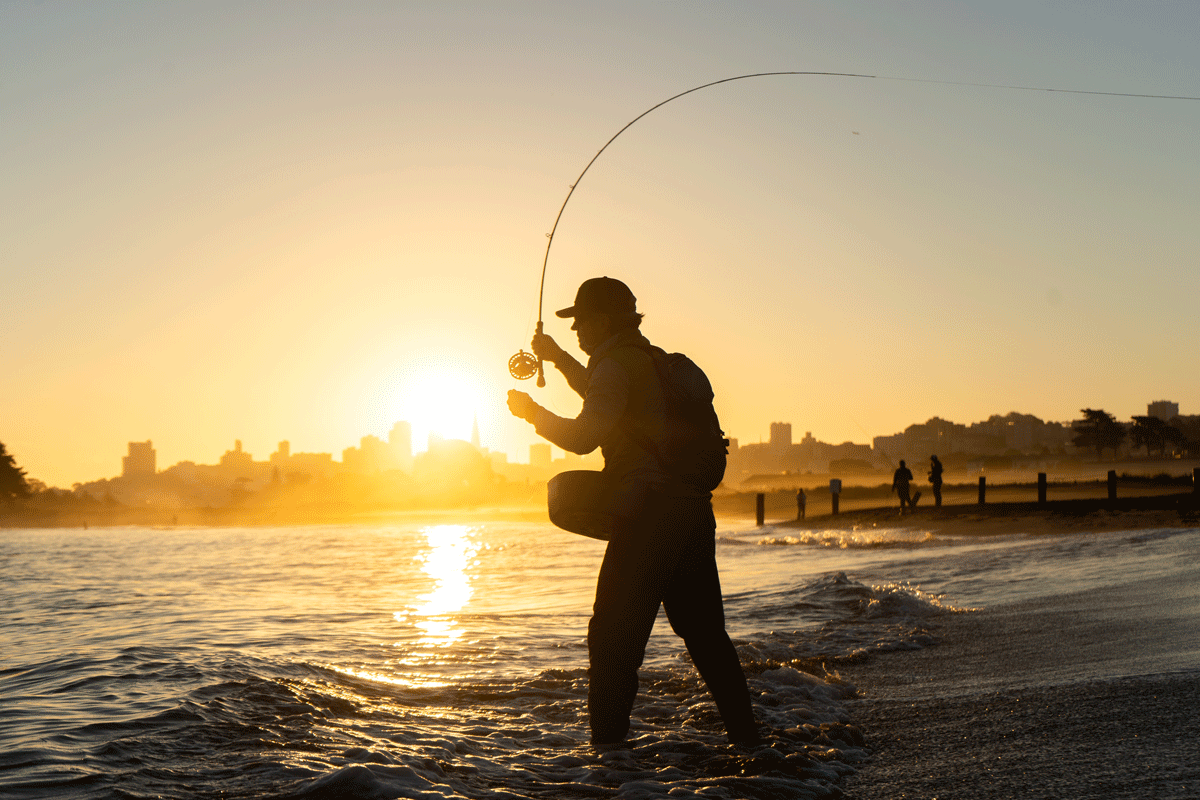
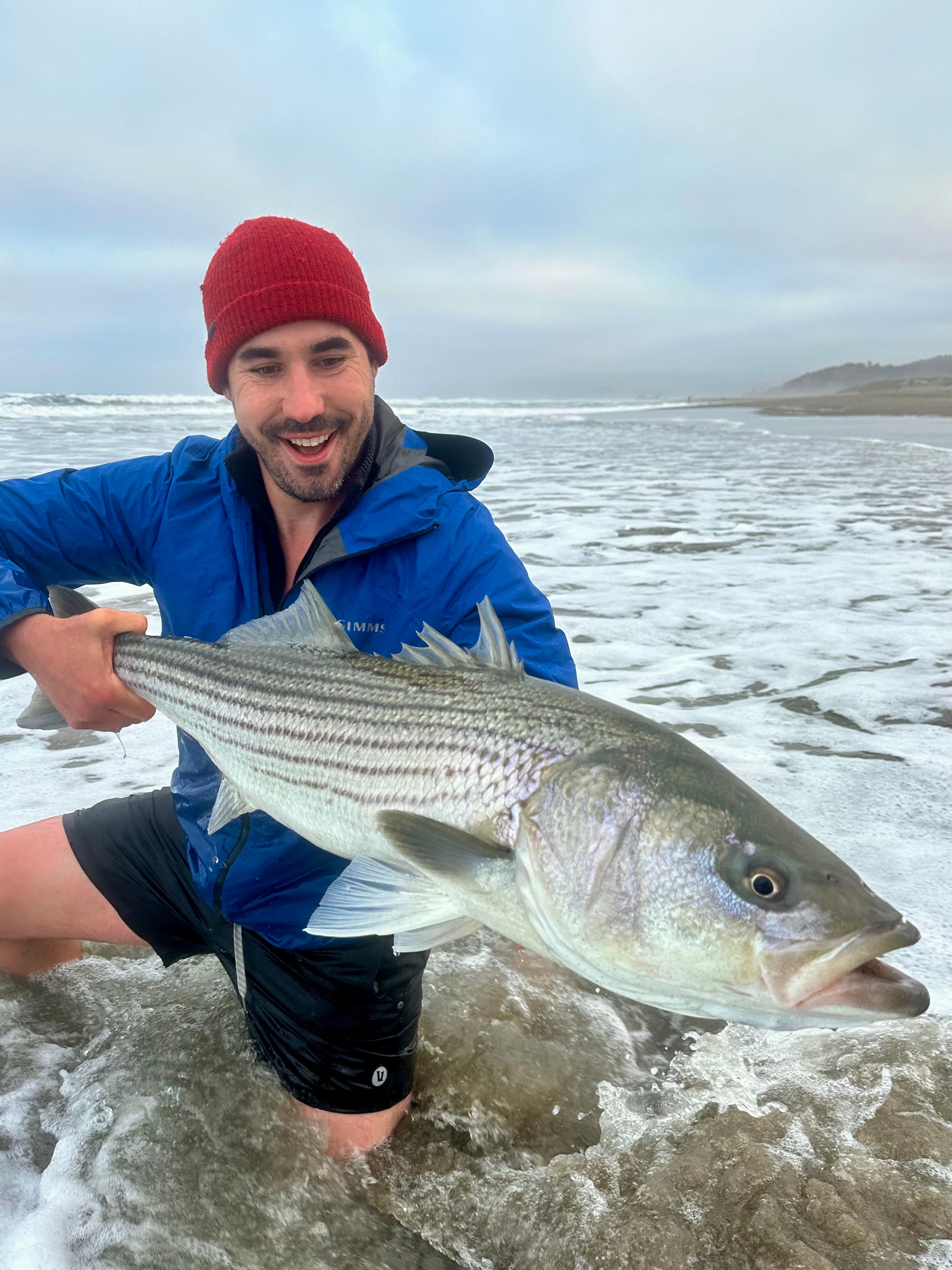
Forget the headlines. San Francisco isn’t just tech bros, fog, and sourdough starters — it’s one of the most underrated fly-fishing cities in America. Surrounded by water on three sides, the City offers a playground for anglers who think differently. On any given morning, you can step into your waders, cross a few blocks of city streets, and find yourself casting into the Pacific surf, the sheltered Bay, or even the historic ponds of Golden Gate Park. Stripers, halibut, and surf perch cruise the shoreline; Chinook sometimes make a surprise appearance.
What makes San Francisco truly special isn’t just its fish. It’s the accessibility — you can reach nearly every fishing spot within 20 minutes. It’s the quality — wild, unpredictable, and more rewarding than any trout stream. It’s the heritage — birthplace of some of the most excellent rods, flies, and casters in history. And it’s the community — anchored by the Golden Gate Angling and Casting Club and the crew at Lost Coast Outfitters.

Video
Why San Francisco Belongs on Every Angler’s Map
The fishiest city in America must have easy and accessible fishing opportunities — and San Francisco delivers. Every fishing area is reachable by foot, public transit, car, or even a self-driving Waymo. Imagine: you could be among the first to take a driverless car to catch a striper.
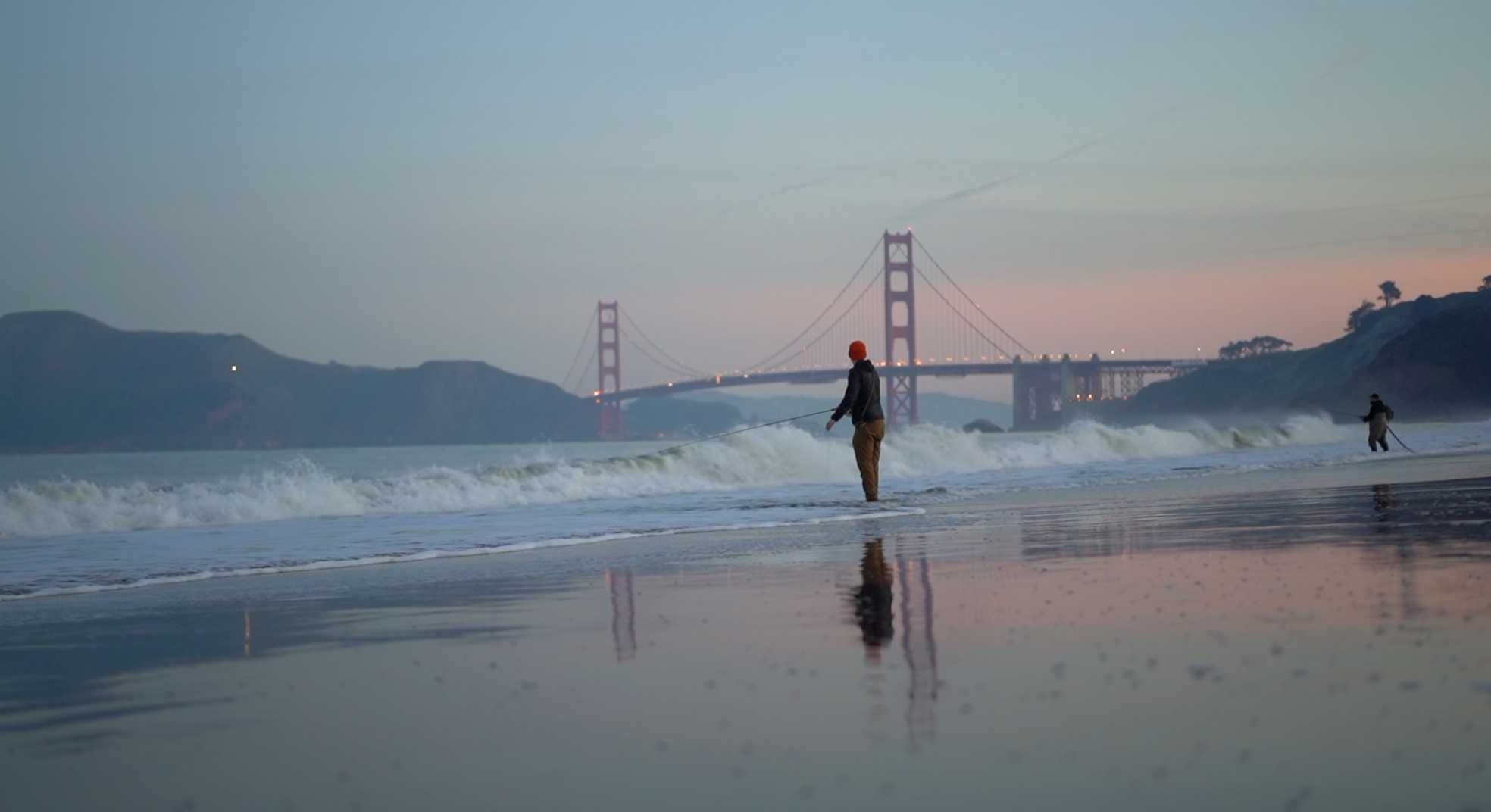
Surrounded by water on three sides, San Francisco offers countless fishing locations. The Pacific Ocean collides with rock and sand on the City’s western edge, creating fishing access at Fort Funston, Ocean Beach, Baker Beach, and China Beach. These five miles of ocean-facing beaches are revered amongst local anglers for the sizable striped bass that patrol the wash. On the City’s north edge, Fort Point guards the base of the towering Golden Gate Bridge. Moving east is Crissy Field’s beginner-friendly shoreline and the tourist-filled piers of Fisherman’s Wharf and the Embarcadero — locally known as “The Bay.” The City’s eastern edge marks the beginning of the South Bay, and heading south you’ll pass Oracle Park, the Chase Center, and Candlestick Park — the former home of the 49ers and a great place to fish.
No matter where you are in this 7-mile-long by 7-mile-wide City, you are no more than 20 minutes from targeting its most notable species: striper, California halibut, and perch. Prime fishing runs April through November. Even the short winter lull is a reasonable trade-off — it happens to coincide perfectly with Dungeness crab season.
Picture yourself standing at the world’s edge, the vast Pacific Ocean in front of you, and one of the world’s great cities at your back. Success is attainable, but the entangled variables of wind, swell, tides, and fish movement make the saltwater angling experience daunting yet incredibly rewarding. While every outing does not reward the angler with a fish, simply being in the game for a once-in-a-lifetime catch makes this an extraordinary fishery. In many ways, it’s far wilder — and more rewarding — than any trout stream.
Shots of City by the Bay
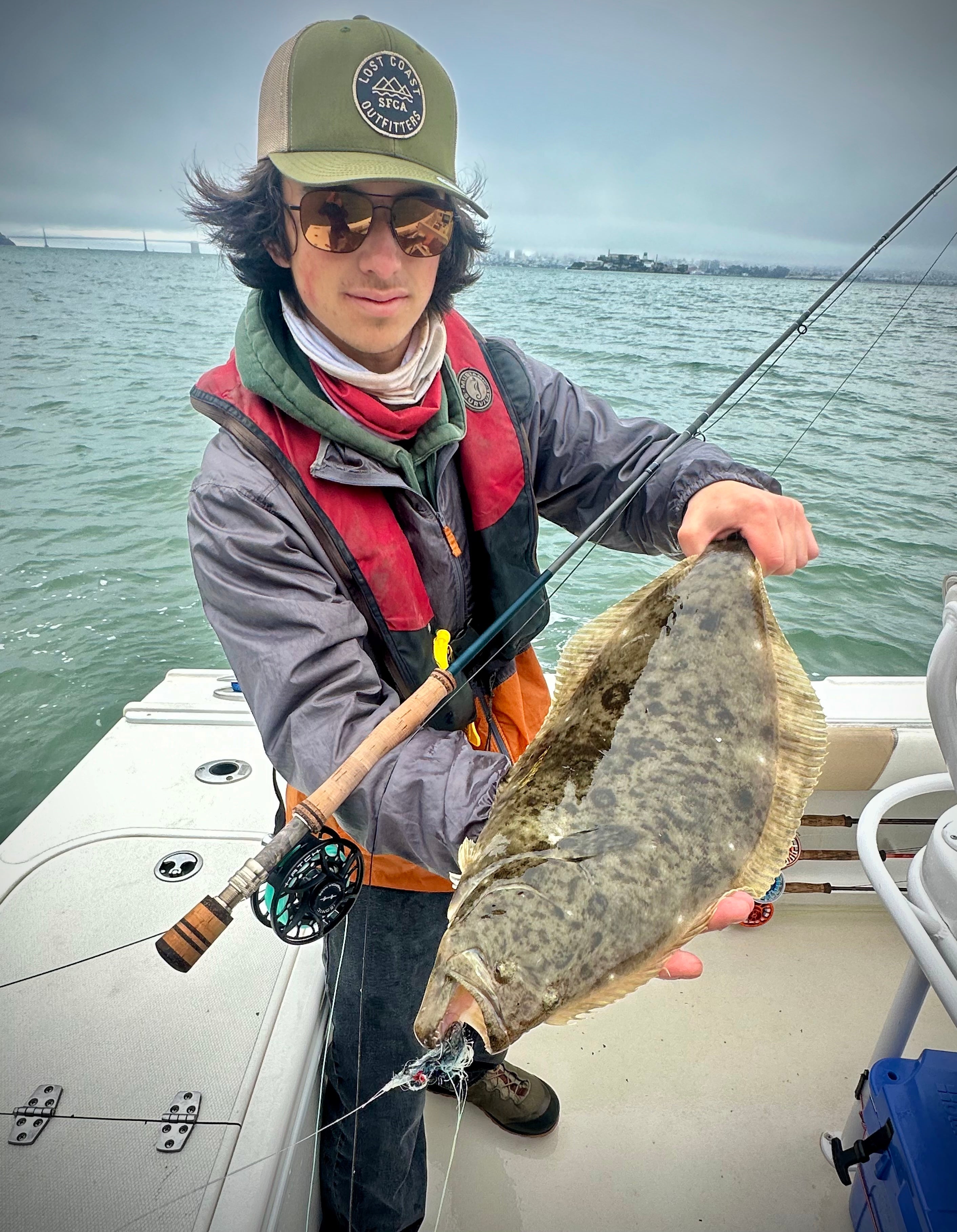
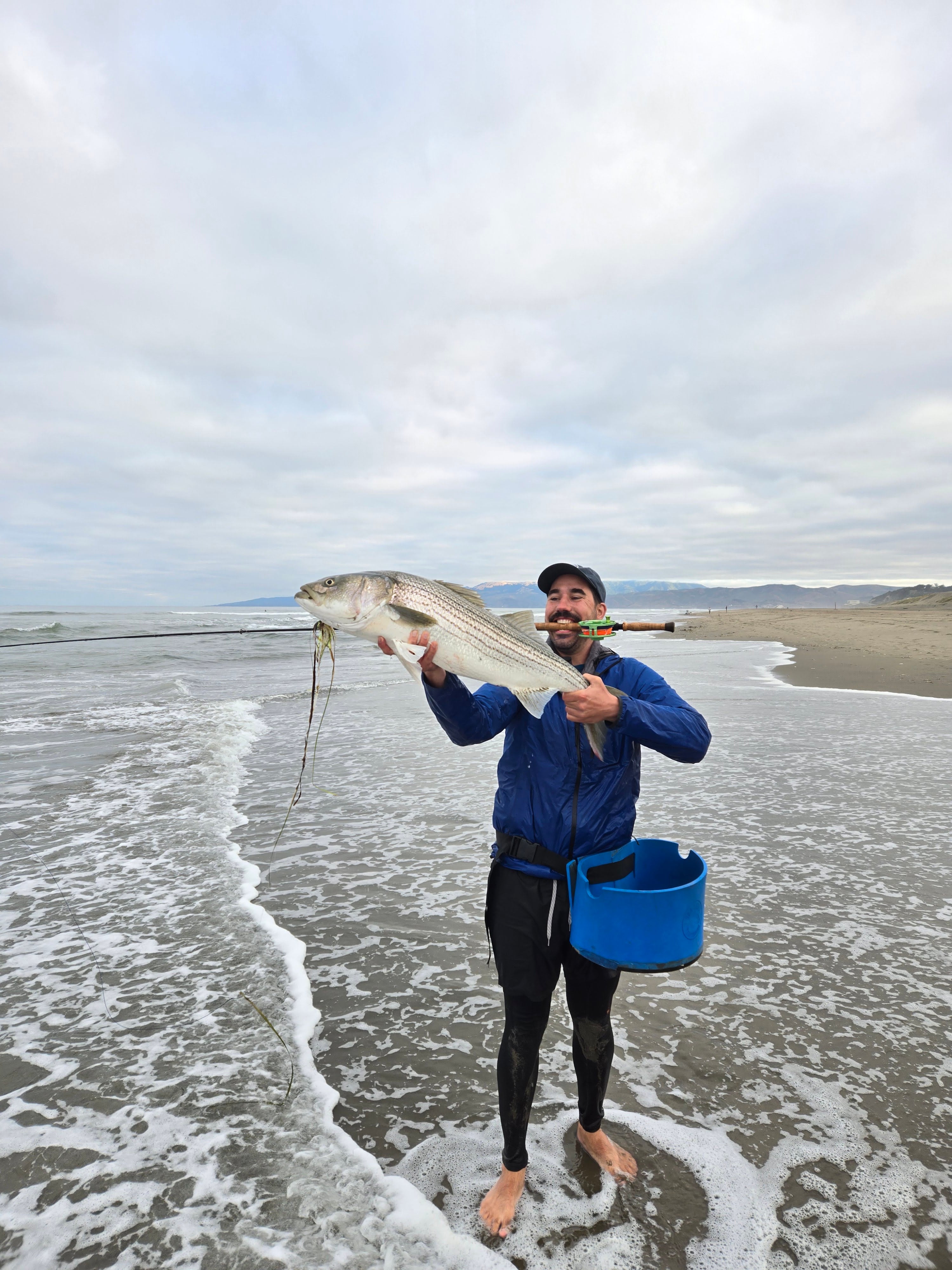
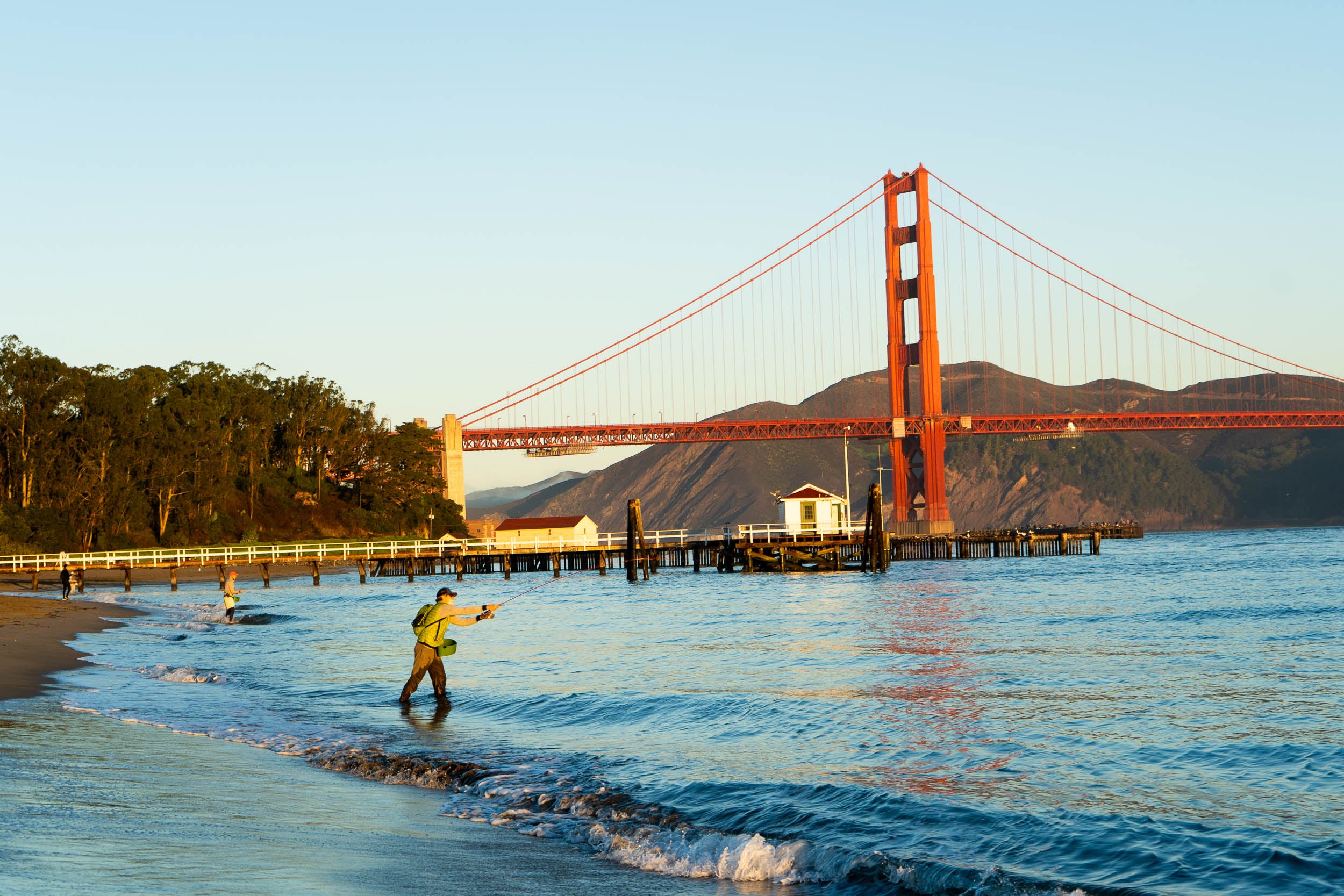
Where to Fish Within City Limits
No matter where you are in this 7-mile-long by 7-mile-wide City, you are no more than 20 minutes from world-class fishing. Here are the essential spots within city limits, from beginner-friendly shores to the wide-open Pacific.
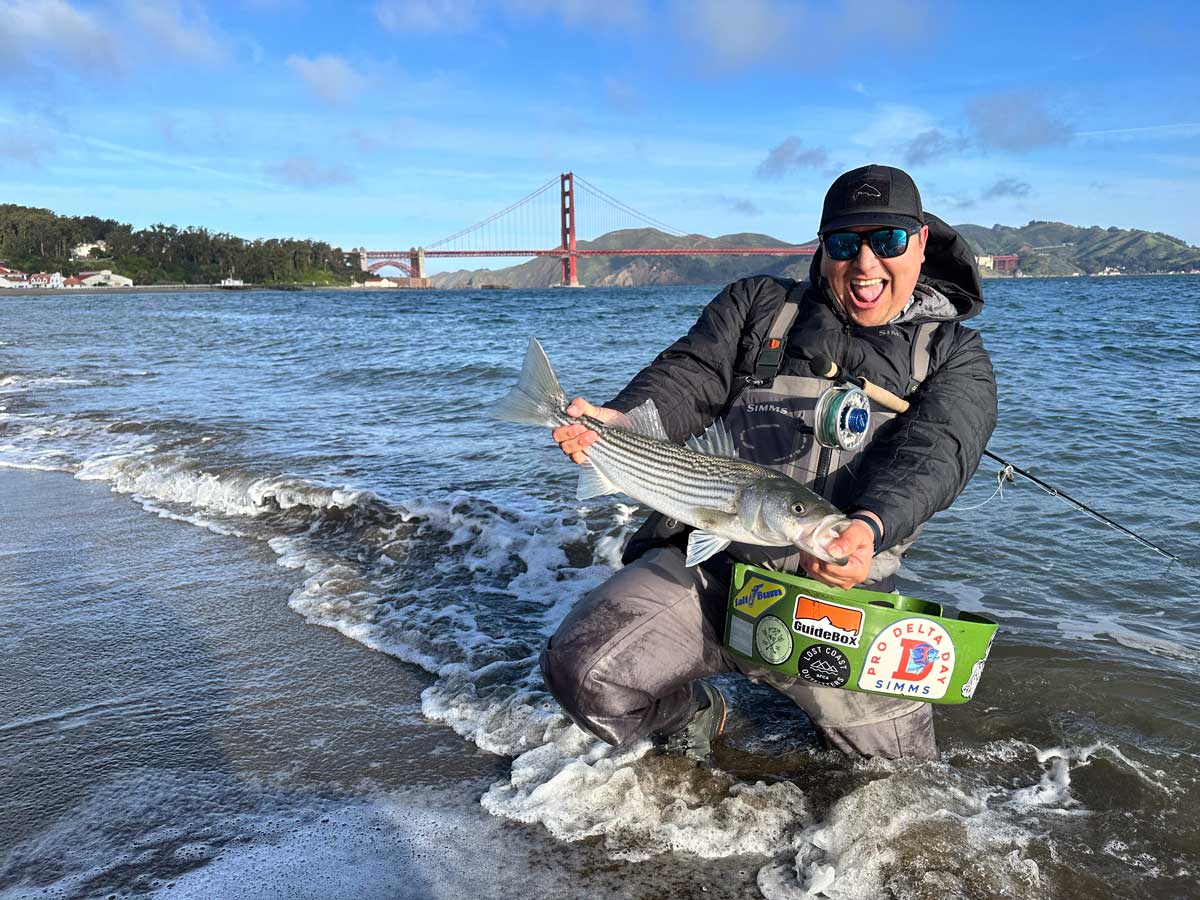
Crissy Field: The Beginner’s Bay
A beach created after the demilitarization of the Presidio, Crissy Field offers majestic views of the Golden Gate Bridge, Alcatraz (worth visiting), and the Palace of Fine Arts — there are even carp in the palace ponds.
Best months: Mid-March through November
Setup: 6–9 wt rod, intermediate or Type-3 shooting head, size 2 surf brown Adachi Clouser on 4–6 feet of 20-lb fluorocarbon. A stripping basket is helpful but not essential here.
Technique: Use aggressive strips punctuated with pauses to entice striper, halibut, ling cod, and even salmon during mid-to-late summer. Strip your fly all the way to your feet — halibut love ambushing close in.
Timing: Get out just before sunrise. The beach is incredibly peaceful in the morning, but dog walkers arrive as the sun comes up — watch your backcast, and crimp the barb. By about ten o’clock, the beach resembles something from the Westminster Dog Show, sponsored by Lululemon.
Gear rentals: If you don’t want to travel with equipment, Lost Coast Outfitters can arrange rentals.
After the session: Rose’s Cafe for a nice sit-down spot, or grab “The Hangover” at Marina Deli if you’re on the move. There are showers in the main Crissy Field parking lot to rinse off.
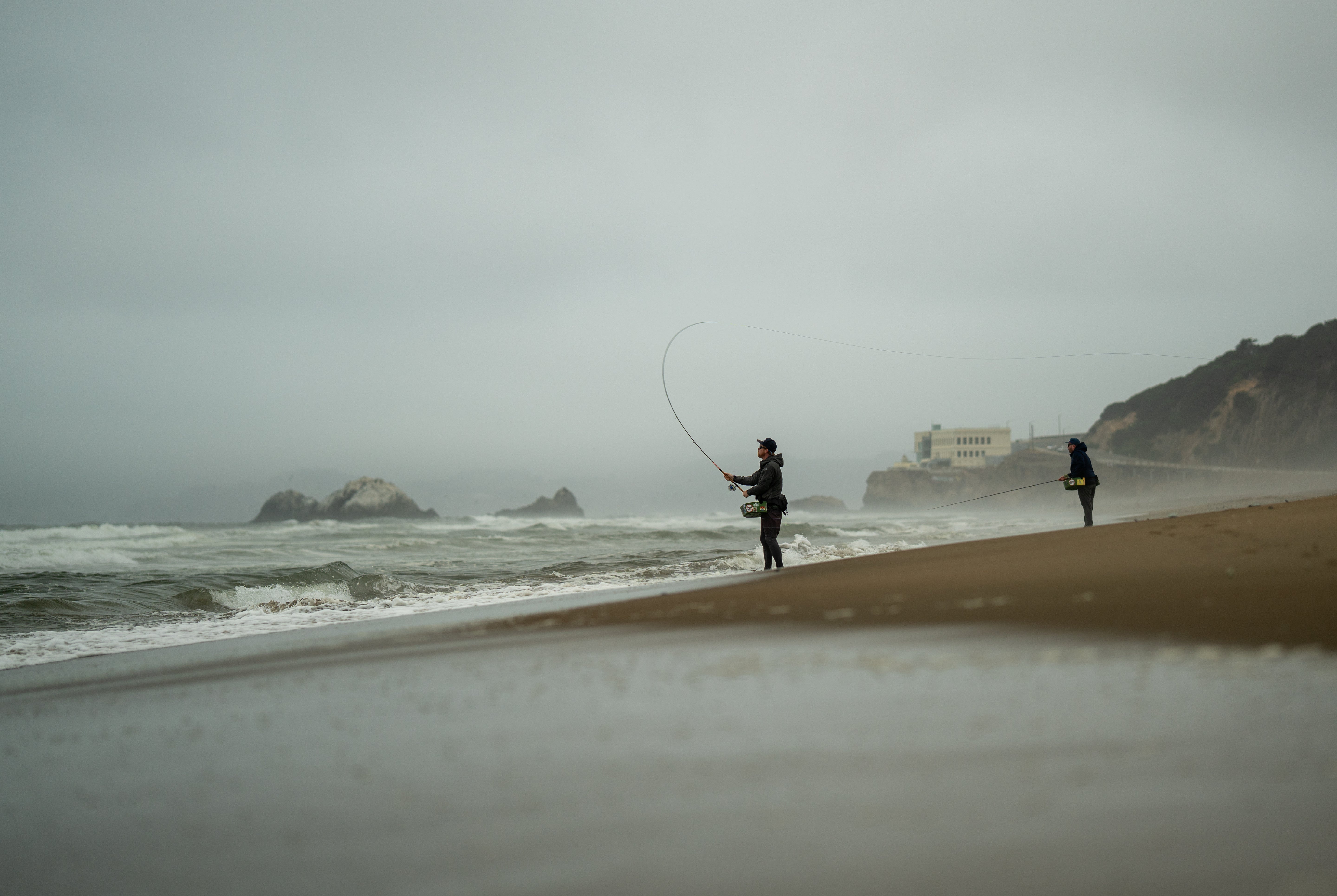
Ocean Beach: The Big-Water Challenge
Your odds of catching a fish on a one-day trip to San Francisco are much better at Crissy than the turbulent Ocean Beach — but the allure of the Pacific Ocean is hard to deny. The waves here are far more significant, with much more force than the beaches inside the Bay.
Best for: Advanced anglers with a solid double haul, May–September
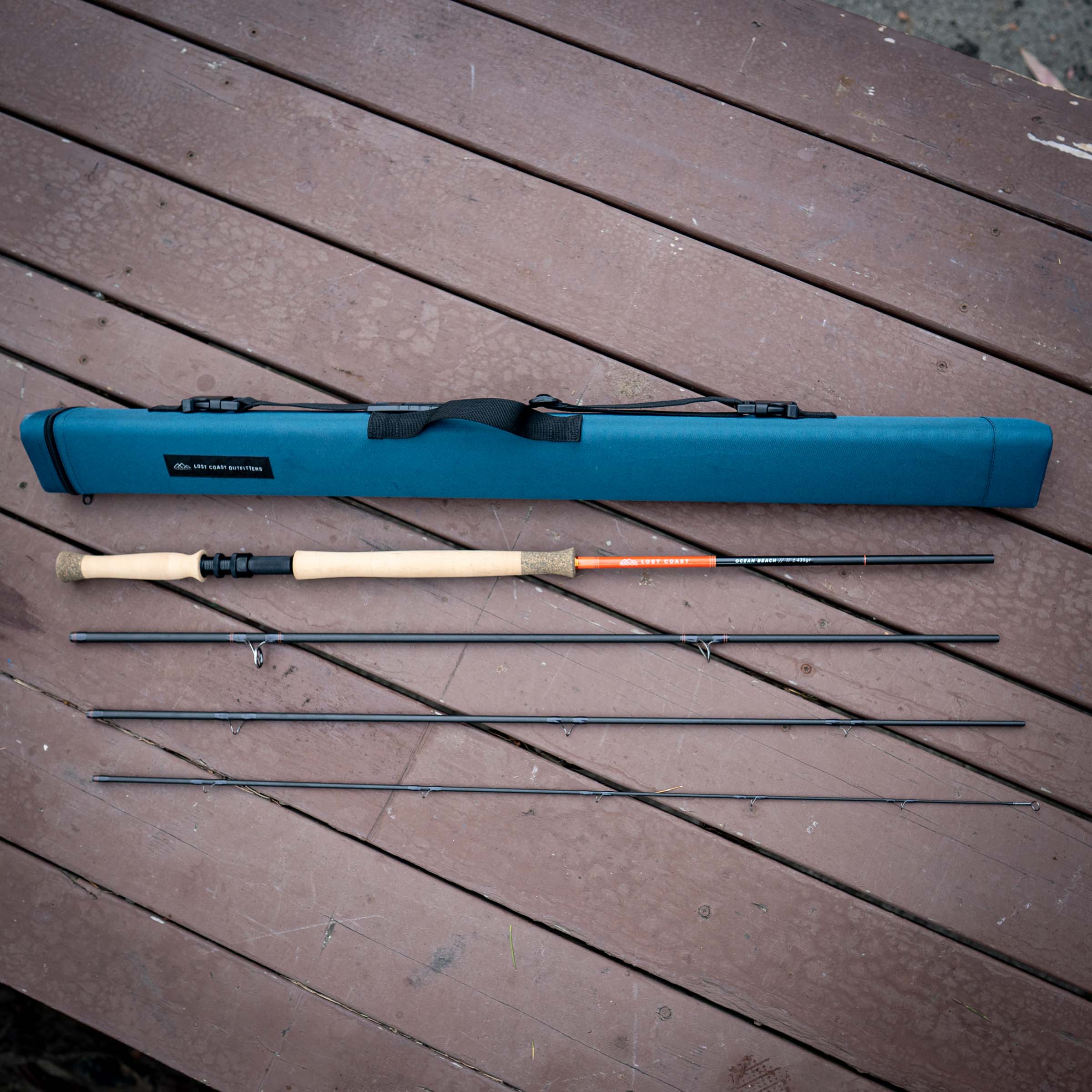
Setup: Lost Coast Outfitters Ocean Beach Surf Fly Rod or a 8–9 wt rod, fast-sinking shooting head (T-14 rigged on 50-lb monofilament running line), 2/0 Adachi Clouser tied on 30-lb leader. A stripping basket is mandatory.
Technique: When fishing Ocean Beach, one must keep their wits about them — swell and wave energy become a significant factor. Make peace with the ocean. Dance with the waves rather than battle them, and never turn your back on the ocean. Find holes and trenches near the beach and fish what’s in front of you. The water from Lincoln to Sloat is prime.
After the session: A breakfast sando at Devil’s Tooth Bakery, or Tartine for the best morning bun you’ll ever eat.
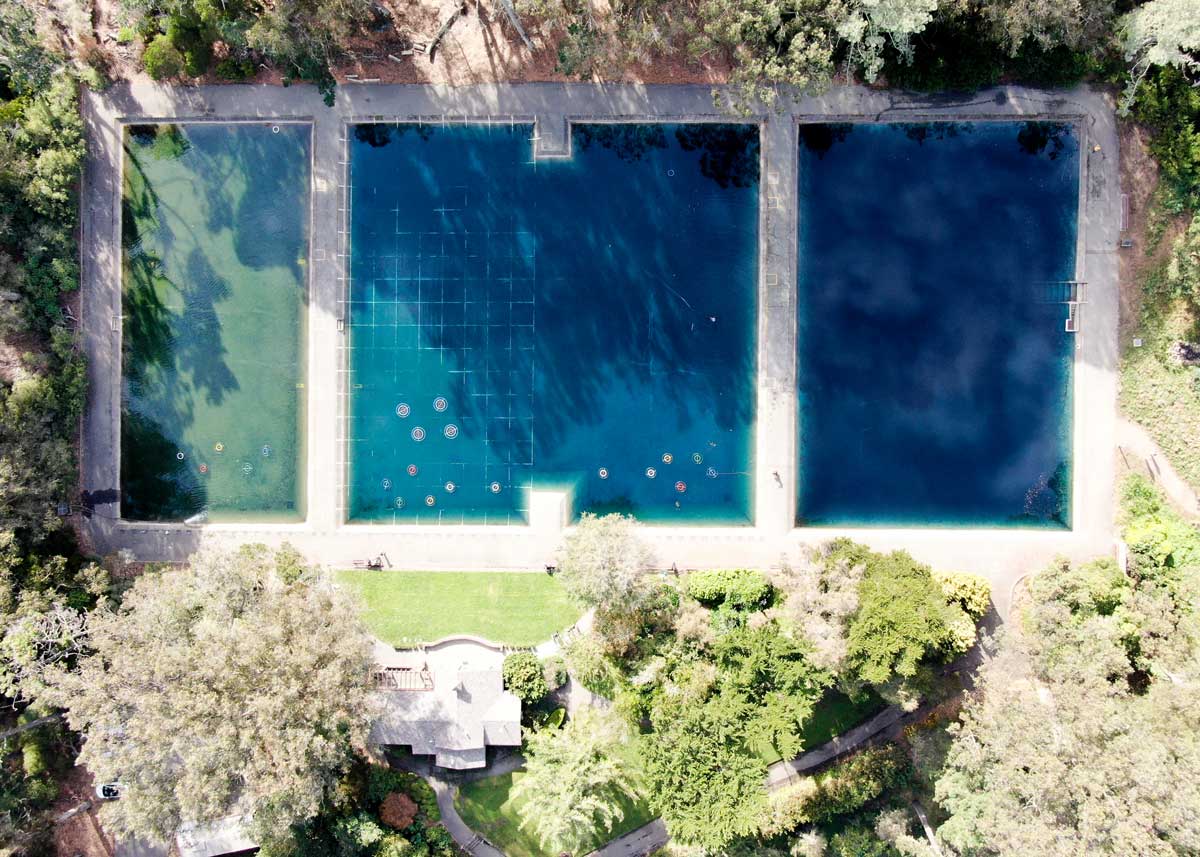
Golden Gate Park Casting Ponds
Built on a mesa in San Francisco’s exquisitely landscaped Golden Gate Park, GGACC offers the most idyllic setting to perfect your cast. Only the faint sirens or occasional passerby are a reminder that you’re in the City. The casting ponds are part of Golden Gate Park and open to all.
What to do:
- Practice your cast in the ponds — there is no better casting facility in the world
- Book a casting instructor through Lost Coast Outfitters to tune up your double haul
- Rinse your gear after a morning of fishing the salt
- If the clubhouse is open, take a tour: artifacts from Cal Bird, Lew Stoner, and even the Dette flies from back east adorn the 90-year-old walls. Russ Chatham’s 1966 World Record Striper hangs above the back door in the locker room.
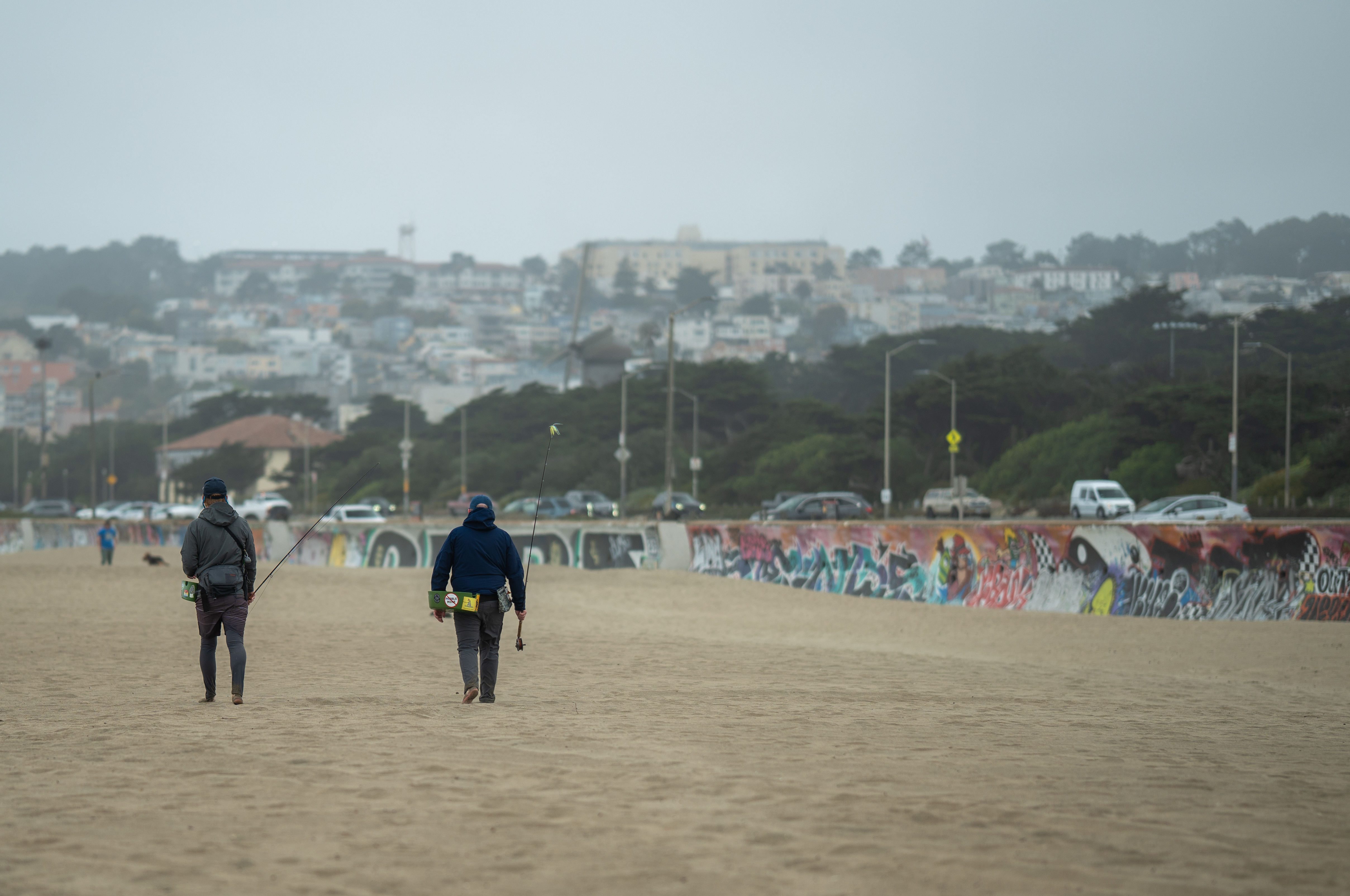
Other Local Spots
- Fort Point / Baker Beach / China Beach — scenic and productive striper haunts.
- South Bay Piers — halibut, perch, and late-summer surprises
- Presidio to Land’s End — great for exploring mid-tide
Gear Up for the Bay
Whether you’re new to salt or a veteran trout bum, the City’s surf requires specialized gear. The combination of wind, waves, and current demands setups that punch through gusts, sink fast, and stand up to the grind of sand and salt. Keeping things simple and salt-ready makes all the difference between fishing and just practicing your casting.
Recommended setups:
6–9 wt rods (switch if windy): A 9' 8wt is the sweet spot for most Bay Area surf sessions — enough backbone to throw heavy lines yet still fun on perch. When the wind howls, a 9wt or light two-hander helps keep your cast efficient and your shoulder intact.
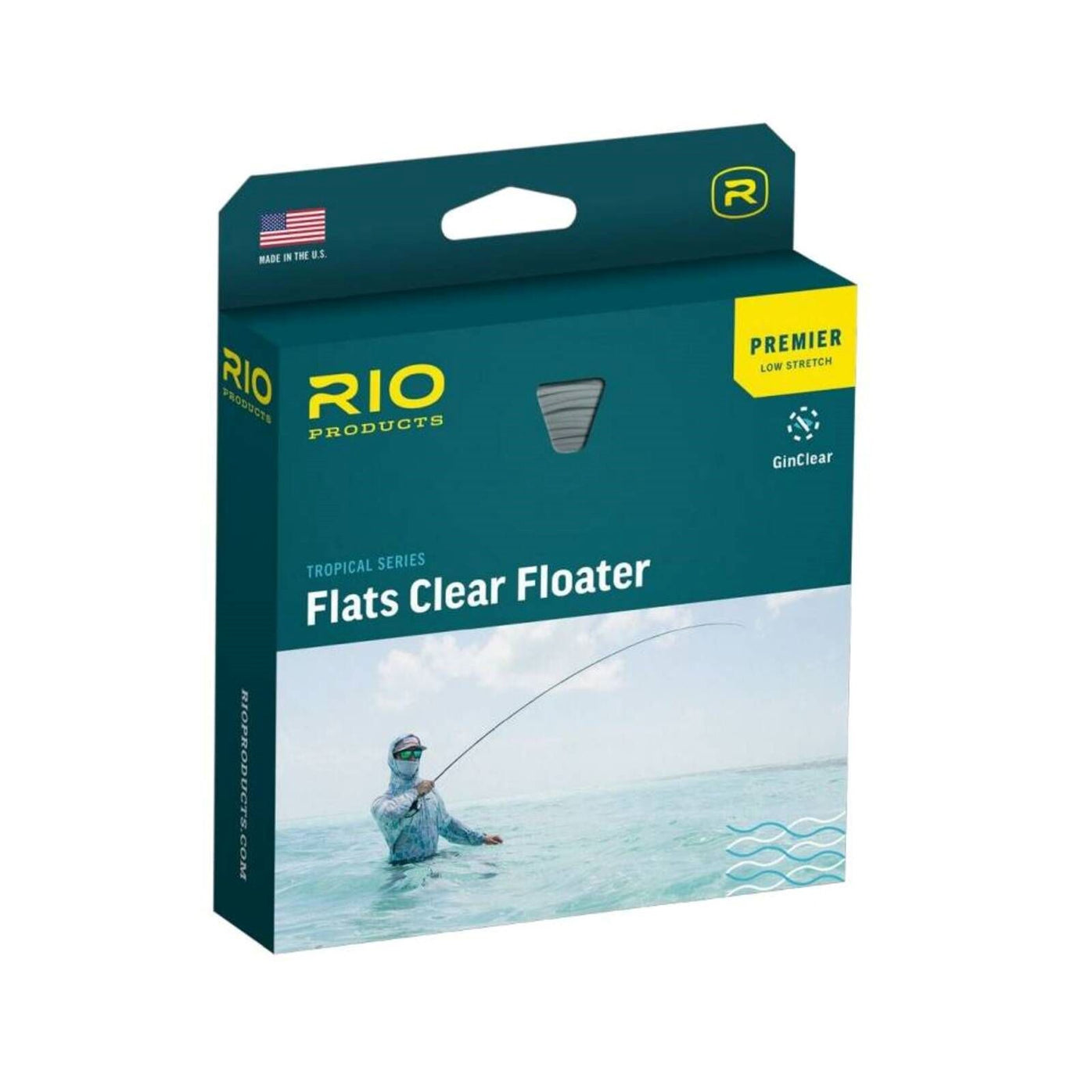
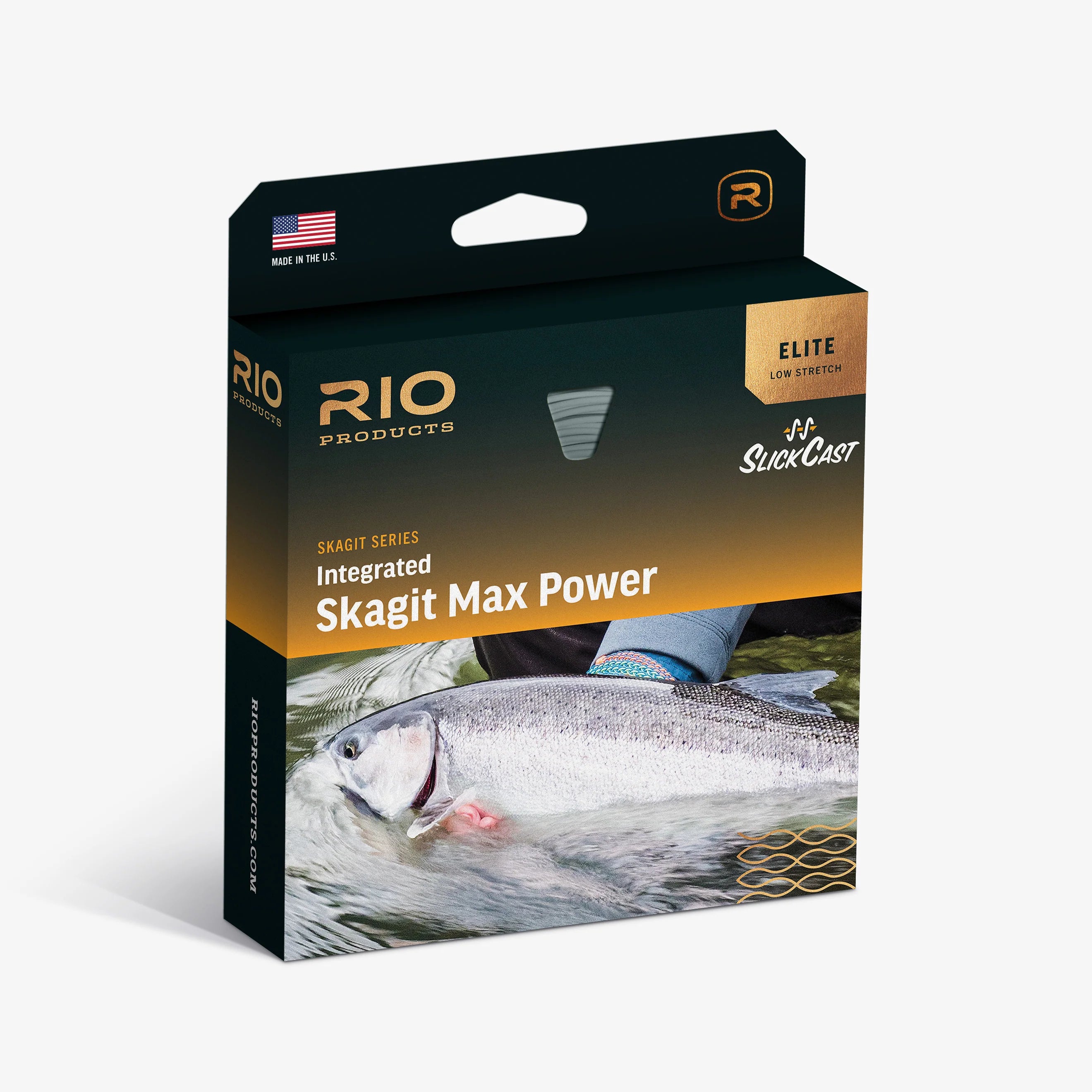
Intermediate to fast-sinking shooting heads: The surf is all about depth control. We fish interchangeable shooting heads that range from intermediate to full sink, letting us adjust to tides and troughs. A Type 3–6 shooting head covers 90% of Bay conditions and makes quick work of casting into whitewater.
Leaders: 20–30 lb fluorocarbon: Keep it short and stout — long leaders just get dragged by waves. A straight section of 4–5 feet is plenty. Fluorocarbon sinks better and resists abrasion from sand and shells.
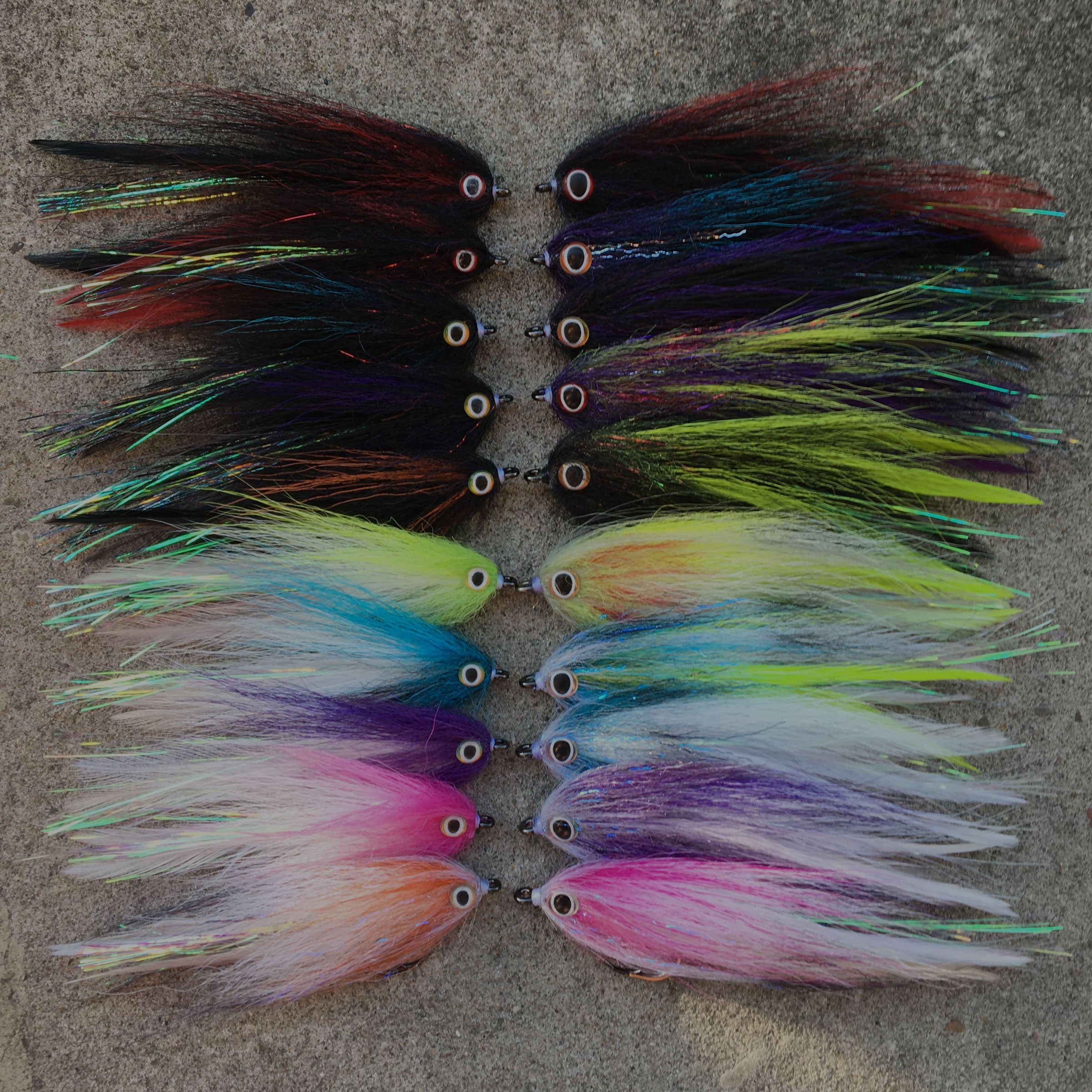
Flies: Adachi Clouser, Surf Scrimp, Gurgler, Sand Crab patterns: Match the food. Bright Clousers for stripers, Surf Scrimps for perch, and crab or shrimp imitations when fish are feeding tight to the beach. Keep your patterns sparse and durable — you’ll be grinding them through sand all day.
Optional: stripping basket (mandatory at Ocean Beach): Don’t skip it. The first time your line wraps your ankles in the wash, you’ll understand why every surf angler swears by a basket. It keeps your line organized, reduces drag, and saves you from endless tangles in the foam.
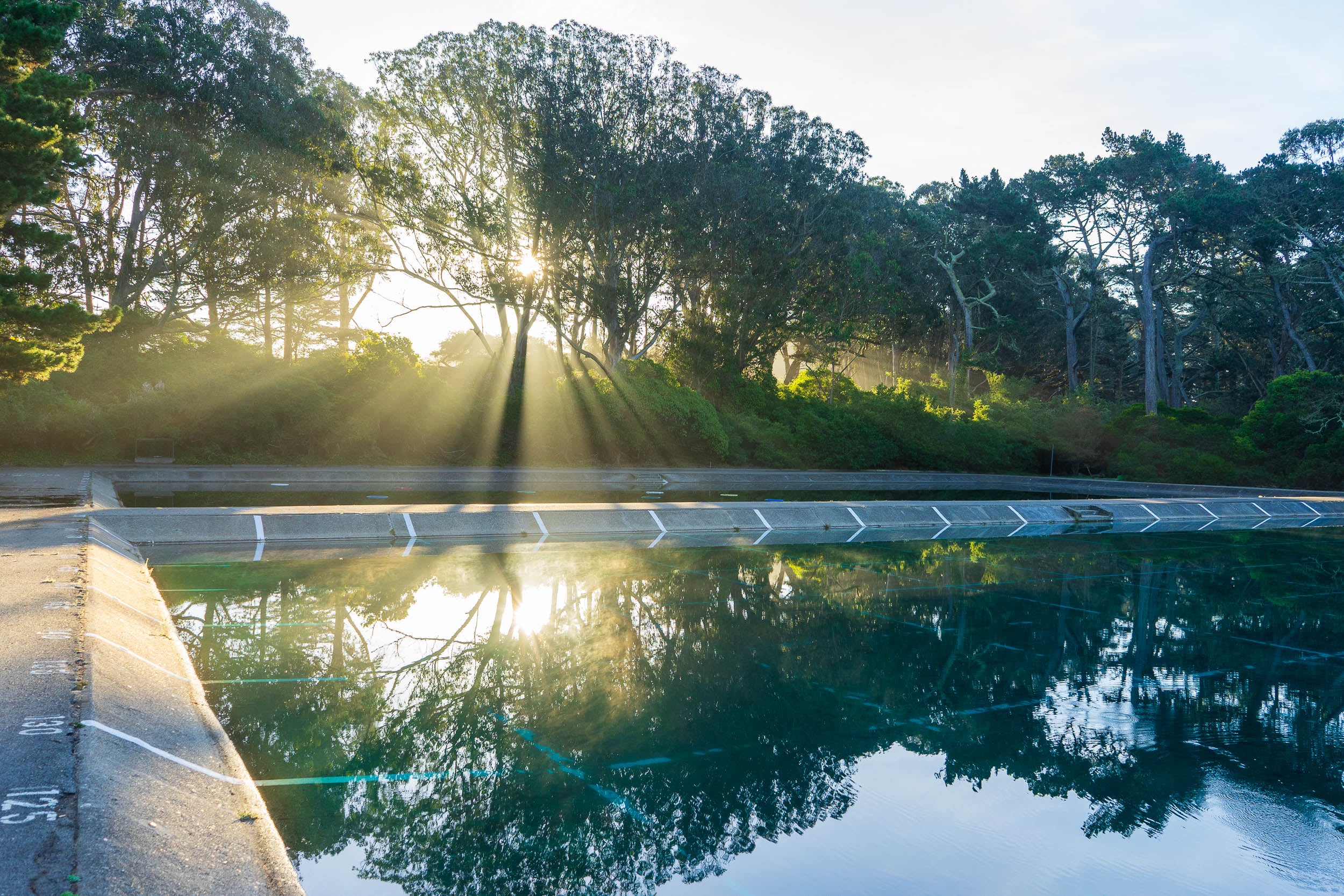
“The Golden Gate Club: it has bred a school of casters who are without any doubt the finest there has ever been.”
A Heritage Steeped in Fly-Fishing Innovation
Fly-Fishing Heritage and Community
What do Winston Fly Rods, Scott Fly Rods, The Curtis Creek Manifesto, and the Birds Nest have in common? They were all created in San Francisco. Curtis Creek Manifesto is arguably fly fishing’s most important book—serving as the sport’s most effective piece of recruitment for nearly 50 years.
Exhibit A: San Francisco’s Rich Fly-Fishing Heritage
In 1929, the Winther-Stone Manufacturing Co. opened for business, soon after changing its name to R.L. Winston Rod Company. In short order, they began collaborating with tournament anglers at the Golden Gate Angling and Casting Club to build rods to win competitions—leading to innovations like the hollow fluted bamboo rod design.
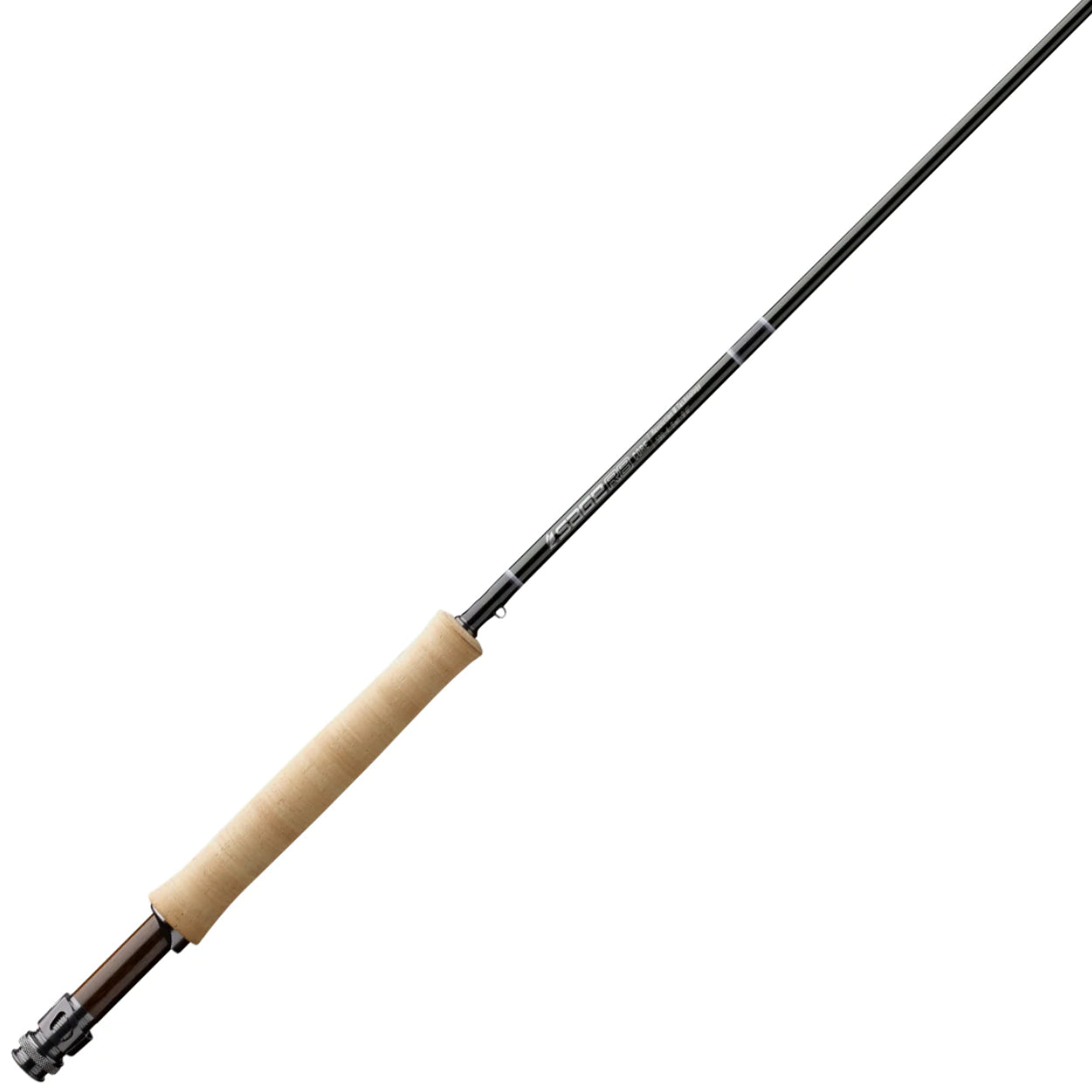
R.L. Winston employed great San Franciscans like Jimmy Green, who later became the rod designer at Fenwick, where he taught Don Green how to cast a fly rod. Don Green would go on to found Sage Fly Rods.
Similarly, Scott Fly Rods sprang up in a basement on Cook Street in the Inner Richmond in 1974. Scott made its mark early with nine-foot graphite rods and the first five-piece rods for Sierra backpackers. GGACC mainstay Larry Kenney was the first employee and later became a partner. Eventually, Scott outgrew its San Francisco roots and moved across the Bay to Berkeley.
Tim and Steve Rajeff grew up on 30th Avenue and Fulton, just a short skateboard ride from GGACC and a few blocks from where Scott Fly Rods began. Both brothers are among the best casters the sport has ever seen. Steve became the winningest casting competitor of all time and head rod designer for G. Loomis Fly Rods, while Tim founded Echo Fly Rods to bring high-performance rods to a broader audience.
Shooting heads were developed for tournament casting and ultimately fly fishing in the city. They have played a significant role in modern line design and taper understanding—especially in the Spey and surf fishing worlds.
Cal Bird, inventor of the famed Birds Nest fly pattern and regarded as a founding fly tyer, was a San Francisco native who owned a fly shop in the 1950s.
Sheridan Anderson, author of the best-selling Curtis Creek Manifesto, lived in the Mission District when he wrote and illustrated his masterpiece.
Mel and Fanny Krieger—travelers, instructors, and pioneers—helped shape modern fly fishing instruction and were instrumental in opening Argentina as a fly fishing destination. They, too, called San Francisco home.
San Francisco resident Val Atkinson is widely regarded as the original fly-fishing photographer, with a body of work spanning more than 40 years of landscapes, portraits, and defining fishing moments.
Built in 1938, the Golden Gate Angling and Casting Club remains the largest community of fly anglers in the world. With three casting ponds and a historic clubhouse in Golden Gate Park, it is still the best place anywhere to learn how to cast a fly rod.
So many notable people and ideas sprang from the City by the Bay that it’s impossible to recognize them all—and even harder to narrow the list to the household names still shaping fly fishing today.
I’ll take heat from my friends at the casting ponds for not mentioning some of the more obscure characters. I can hear it now: “How can you not tell the story of how Jack Horner invented the humpy?” There will be gasps. Longtime members would never utter the word “humpy”—they would call it by its proper name: the Horner Deer Hair.
Given the points above, it’s no surprise that a long list of notable inventions, techniques, companies, and people hail from the Golden City—an impressive who’s who of fly fishing lore. The genesis of this was likely a combination of the region’s entrepreneurial culture and the storied Golden Gate Angling and Casting Club.
So, Is San Francisco America’s Fishiest City?
The Verdict: San Francisco’s Fishiest City Score Card
Considering its miles of beaches, the number and quality of species that one can target within city limits, its rich history of companies, innovators, and contributions to the fly-fishing industry, and its vibrant community of hard-core anglers — it’s easy to deem San Francisco as America’s Fishiest City.
- Ease of Access — A+: Could be blacked out in a Waymo and still get to the beach to go fishing.
- Duration — A–: Year-round with a short 3-month lull — which coincides perfectly with Dungeness crab, duck, and Steelhead seasons.
- Quality — B+: Photo ops are exceptional; the fish can be epic. It demands patience and rewards skill.
- Heritage — A+: Winston, Scott, the Rajeffs, Cal Bird, the Curtis Creek Manifesto — all born here.
- Community — A+: The most incredible group of people you will ever meet.
- Overall Grade: A.
While I have traveled to every state, I don’t know them as intimately as San Francisco. If you believe you know a better city to be an angler, write to us.
24 Hours in San Francisco: The Angler’s Itinerary
If You Go: 24 Hours in San Francisco
The best weather and fishing are in the first weeks of May and again in October, when temperatures are reliably in the 70s. The City’s mild climate does catch some visitors off guard—a San Franciscan never leaves home without a jacket.
Where to Stay
- For the discerning traveler: Lodge at the Presidio near Crissy Field.
- On a budget: Seal Rock Inn by Land’s End.
Morning
Hit the beach before dawn. Crissy Field is the better option for beginners, while Ocean Beach is better suited to advanced anglers with a solid double haul. The beach is incredibly peaceful before sunrise. Watch your backcast as dog walkers arrive, and crimp the barb.
Midday
Head to GGACC in Golden Gate Park for a casting session. Rinse your gear in the ponds. If the clubhouse is open, tour the locker room and main room—Russ Chatham’s 1966 World Record Striper hangs above the back door.
For lunch, head to Swan Oyster Depot for sourdough and Dungeness crab, or Tlaloc Sabor in the Financial District. In North Beach, Golden Boy Pizza and Molinari’s Delicatessen are both excellent options, with Molinari’s serving San Francisco since 1896. Enjoy lunch at Washington Square Park—you might recognize it from the cover of Trout Fishing in America.
Afternoon
Stop by Lost Coast Outfitters at 540 Jackson Street in Jackson Square. Test rods on historic Gold Street in front of the former assay office where gold and silver were tested for quality in the 1800s. Stock up on local flies—thousands of unique patterns are neatly organized in this Jackson Square gem. Come after 4 p.m. and there’s usually a beer or whiskey waiting.
Evening
Midday winds typically pick up, then calm in the last 30 minutes of light—head back to the surf for the best sunset in the world with the beach to yourself.
Or skip the second session and settle in at Vesuvio, Comstock, or Spec’s for a beer, or cocktails and dinner at Bix. Staying out late? Sam’s Burgers—featured on Layover—is there for you until 1 a.m.
Join San Francisco’s Fly-Fishing Community
For a period of time, San Francisco was without a fly shop. Believing wholeheartedly that a world-class city deserved a world-class fly shop, we opened Lost Coast Outfitters in 2013. We take pride in taking care of people and sharing our knowledge in a warm and welcoming setting.
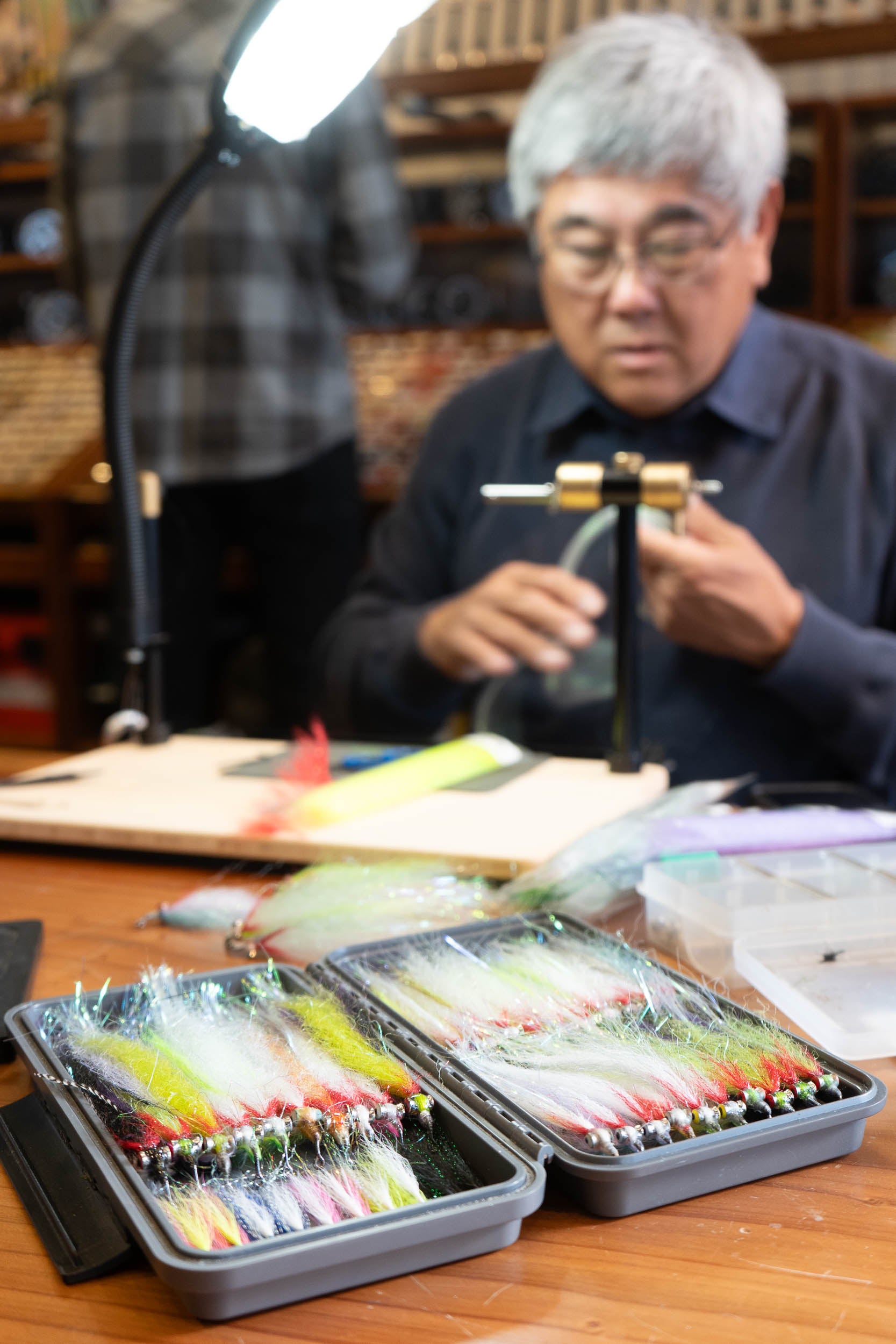
You can expect a vast and curated selection of gear from the best brands in fly-fishing, and some of the best fly shop staff and dogs in the industry. Thousands of unique fly patterns are neatly organized in this Jackson Square gem. Fly tying materials can be found in the back room. The shop sits on the old Barbary coastline, on the edge of where a creek entered the Bay at the confluence of Jackson Square, the Financial District, Chinatown, and North Beach.
You can test fly rods on Gold Street at Balance Street — in front of the former assay office where gold and silver were tested for quality in the mid-to-late 1800s.
Pro Tip: parking can be tough. There are two spots in front of the shop and four garages within two blocks.
Whether you’re planning your first surf outing, tuning your double haul at GGACC, or gearing up for a road trip north, we’ve got everything you need — rods, lines, flies, lessons, and local knowledge.
Visit Us: Lost Coast Outfitters, 540 Jackson St, San Francisco, CA
Take a Class: Surf Fly Fishing + Casting Lessons
Follow the Journey: @Lcoflyfishing
If you’re going to San Francisco, be sure to pack a fly rod.
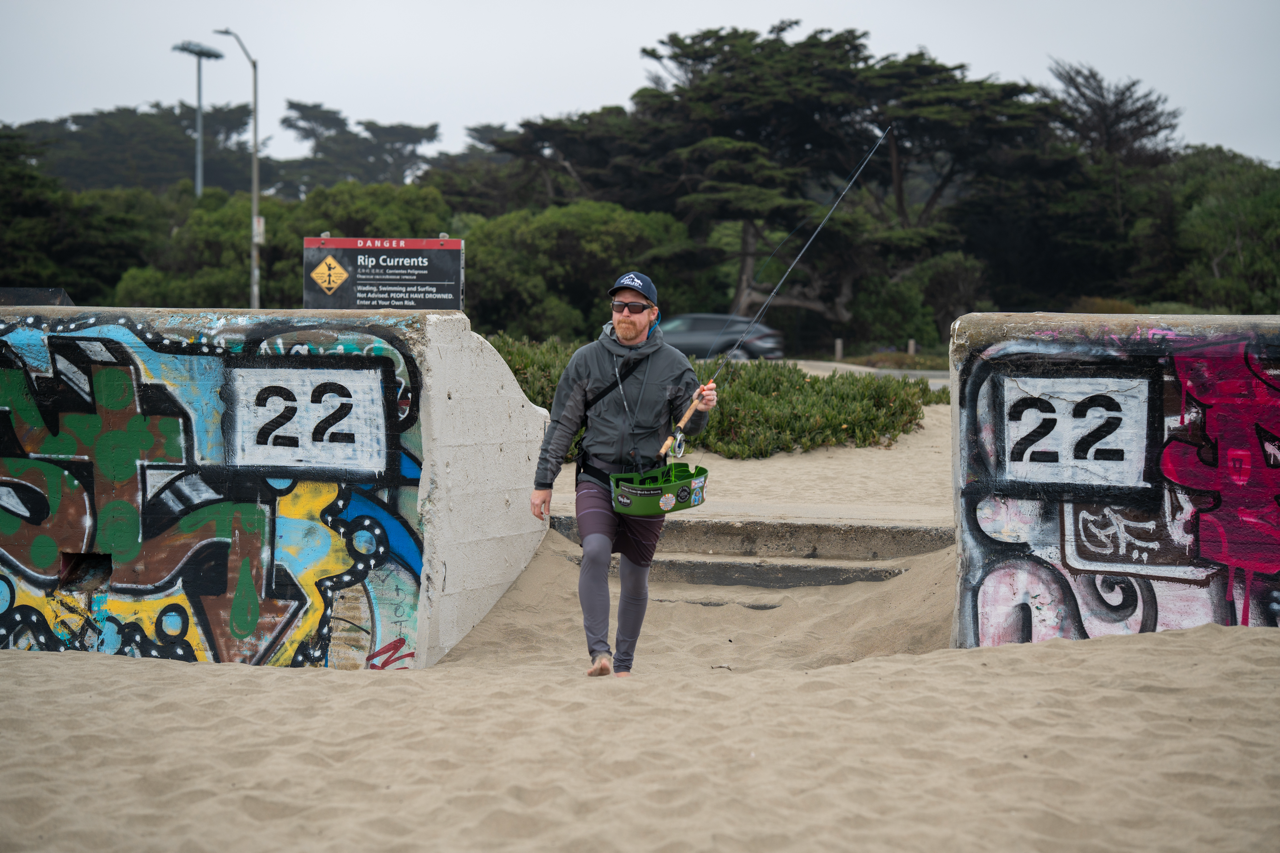
If you're new to the area, going with a guide is a great way to start. Or hit us up to get set up.
